

A structured, phased roadmap — from T-12 months to poll day.
A phased campaign roadmap ensures operational readiness, voter alignment and seamless poll-day execution. Engagements run on 1-, 2- or 5-year terms.
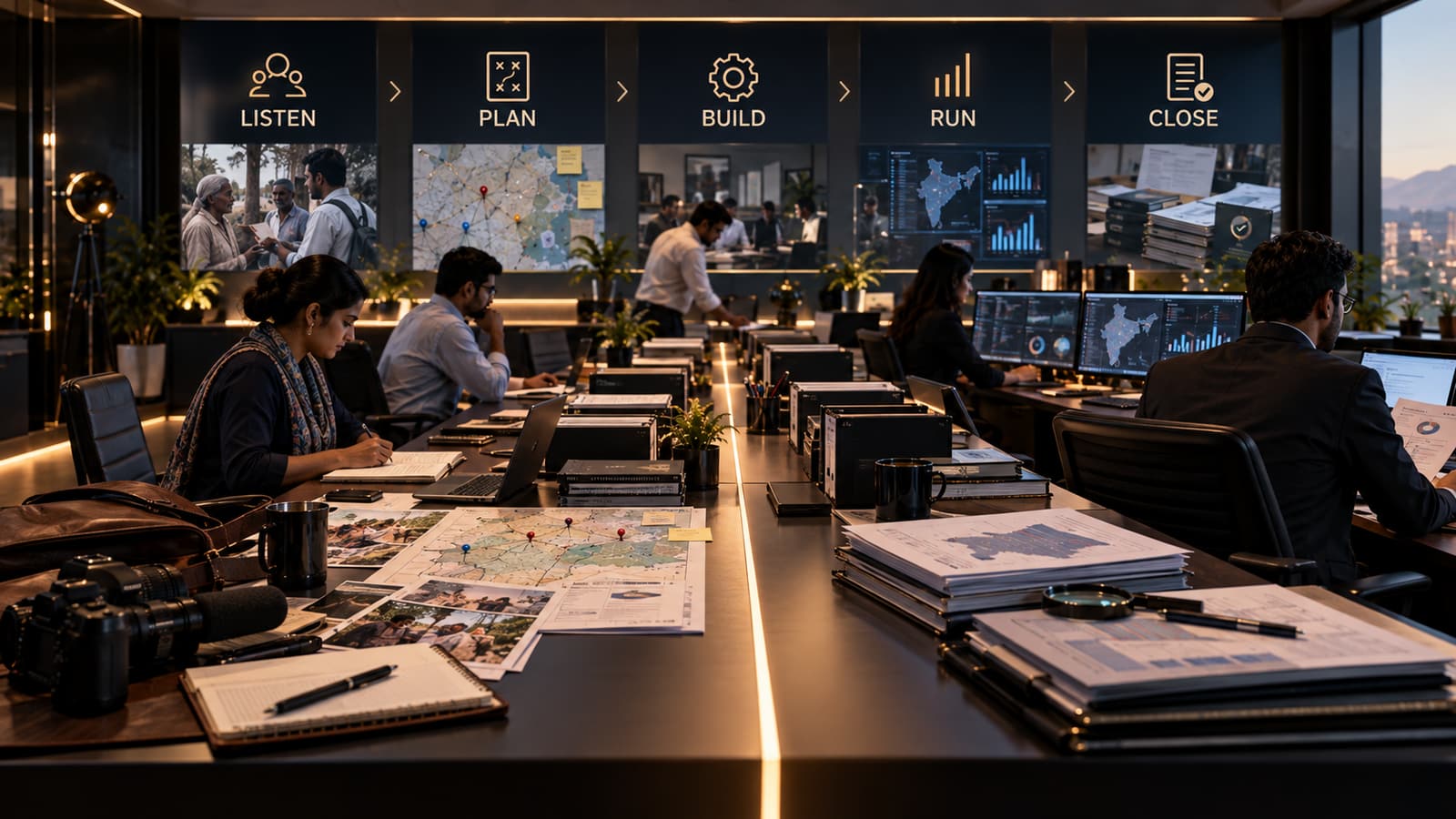
Any consultancy can produce a strategy document. The question a candidate should ask is what it was built from, how often it is revised, and who is accountable when the ground contradicts it. Here is how we answer all three.
Our process
From first conversation to campaign execution
Every engagement begins with understanding the client, the constituency and the political objective. Ten steps take it from briefing and assessment to strategy, onboarding, execution and measurable results.
Brief → Assess → Strategise → Present → Onboard → Execute → Monitor → Optimise → Final phase → Review
- 01
Initial conversation
Listen. Understand. Define.
A confidential discussion to understand the candidate or organisation, electoral objectives, constituency, timeline, existing resources and immediate challenges.
- 02
Briefing & requirement assessment
Define the assignment.
The initial discussion becomes a structured campaign brief covering objectives, scope of work, geography, target deliverables, manpower requirements and campaign timelines.
- 03
Political & constituency assessment
Research before recommendation.
Political, demographic, electoral and constituency-level information is assessed to understand the operating environment and identify strategic requirements.
- 04
Strategy & proposal
Build the roadmap.
A customised strategic framework covering campaign priorities, execution architecture, team structure, communication, field operations, monitoring and timelines.
- 05
Presentation & discussion
Align expectations.
The proposed strategy, scope, deliverables, team structure, timelines and commercial terms are presented and refined through discussion with the client.
- 06
Onboarding
Move from plan to action.
The campaign command structure is established, the responsible team appointed, reporting channels and communication protocols defined, and the campaign calendar created.
- 07
Campaign execution
Strategy meets the ground.
Teams execute the approved plan across research, field operations, public outreach, digital communication, constituency management, booth-level activities and other agreed components.
- 08
Monitoring & course correction
Measure. Review. Adapt.
Progress is monitored through structured reporting, field feedback, intelligence inputs and performance indicators. Where required, strategies and deployment are adjusted.
- 09
Final phase & poll-day preparedness
Execute with discipline.
Intensified coordination, communication, field monitoring and polling-day preparedness according to the agreed campaign plan.
- 10
Review & results
Measure the work. Document the learning.
Key activities, outputs, field intelligence and agreed performance indicators are reviewed and documented to support future political and organisational planning.
The roadmap
From T-12 months to poll day
A structured, phased campaign roadmap ensures operational readiness, voter alignment and seamless poll-day execution.
- T-12 months
Strategic foundation & groundwork
- Data & demographic analysis — booth-level voter profiling, past election trend mapping and socio-economic voter segmentation.
- Cadre & infrastructure setup — core campaign team (Operations, HR, Media, Strategy); party office bearers mapped down to the booth.
- Issue identification — constituency-wide surveys for key local issues, voter grievances and opposition vulnerabilities.
- Branding & positioning — the candidate’s primary narrative, core messaging pillars and baseline digital footprint.
- T-6 months
Field mobilisation & voter engagement
- Targeted outreach — issue-based public drives, youth engagement programmes and door-to-door canvassing.
- Digital & media scaling — structured social media campaigns, localised WhatsApp networks and regional PR.
- Booth committee formation — Panna Pramukhs (page in-charges) and booth captains appointed and verified across every polling station.
- Opposition counter-strategy — real-time media monitoring and policy research to counter opposition narratives.
- T-3 months
Acceleration & voter persuasion
- High-decibel campaigns — mega rallies, public meetings and targeted town halls with key demographic groups.
- Voter micro-targeting — messaging refined for undecided voters through personalised WhatsApp broadcasts and voter slips.
- War room operationalisation — a 24/7 central war room for real-time media tracking, rapid crisis management and resource allocation.
- Cadre training & drills — workshops for booth agents on voter-list verification, election law and GOTV protocols.
- Final weeks
Peak mobilisation & silent period T-2 weeks → T-48 hours
- Intensive door-to-door canvassing — the final wave of direct voter contact, literature and voter slips.
- Cadre motivation & logistics — transport, meals and emergency funds for ground teams and booth agents.
- Silence period management — transition from public rallies to silent, localised ground operations and peer-to-peer messaging.
- Poll day
Execution & GOTV T-0
- Booth deployment (6:00 AM) — agents inside polling stations, mock polls completed and verified.
- Real-time turnout tracking — turnout monitored hourly; mobile teams mobilise slow-turning targeted segments.
- Legal & crisis response — booth-level disputes, EVM glitches and voter-list discrepancies handled by dedicated legal/compliance cells.
- Form 17C & EVM security — signed polling records collected; EVMs escorted to the strong room.
What you receive
- A written strategy document, signed off and version-controlled
- A weekly campaign report with the numbers behind it
- Booth-level coverage and verification data
- A named senior point of contact throughout
- A monthly recalibration meeting with fresh survey data
- A post-poll analysis report

Want to see what our first phase would find in your seat?
Tell us the constituency. We will prepare an initial read and walk you through it.